Your drip campaigns are probably leaving money on the table.
Look, "set it and forget it" worked in 2019. Not anymore. Today's subscribers can smell a lazy automated sequence from a mile away. They expect emails that actually feel like they were written for them.
This guide covers the drip campaign best practices that separate mediocre sequences from revenue machines. No fluff. No theory. Just what actually works.
Here's what you'll learn:
- How to segment audiences so messages hit home
- When to use behavior triggers (and when time-based is fine)
- The timing sweet spot that avoids inbox fatigue
- A testing framework that compounds results over time
Ready? Let's get into it.
1. Segment Your Audience for Personalized Messaging
Stop sending the same email to everyone. Seriously.
Audience segmentation means splitting your list into smaller groups based on shared traits. Job titles. Purchase history. How they found you. Whatever makes sense for your business.
Here's why this matters: A new subscriber who just downloaded your beginner guide needs completely different content than a repeat customer who's bought from you three times. Sending them the same drip sequence is lazy, and it tanks your results.
Why Segmentation Works
Spotify doesn't send everyone the same "New Music Friday" email. They customize it based on what you actually listen to. That's why it works.
Think about your own inbox. Generic emails get deleted. Personalized ones get opened.
An e-commerce store can segment customers who haven't purchased in 90 days and send them a re-engagement sequence with a special offer. That's infinitely more effective than blasting your entire list with the same newsletter.
How to Actually Do This
Start simple. You don't need 47 segments on day one. Start with three or four: new subscribers, first-time customers, repeat buyers, and inactive contacts.
Use progressive profiling. Don't ask for everything upfront. Use your drip emails to collect more data over time. One question per email. "What's your biggest challenge right now?" builds richer profiles without being annoying.
Layer your criteria. Segment users who visited your pricing page twice but haven't signed up. They're clearly interested. Send them a drip campaign that addresses common objections.
Audit quarterly. People change. Review your segments every few months. Move contacts around. Remove the dead weight.
For more on this topic, check out our guide to email segmentation strategies that actually move the needle.
2. Map Emails to the Customer Journey
Sending the right message at the wrong time is almost as bad as sending the wrong message entirely.
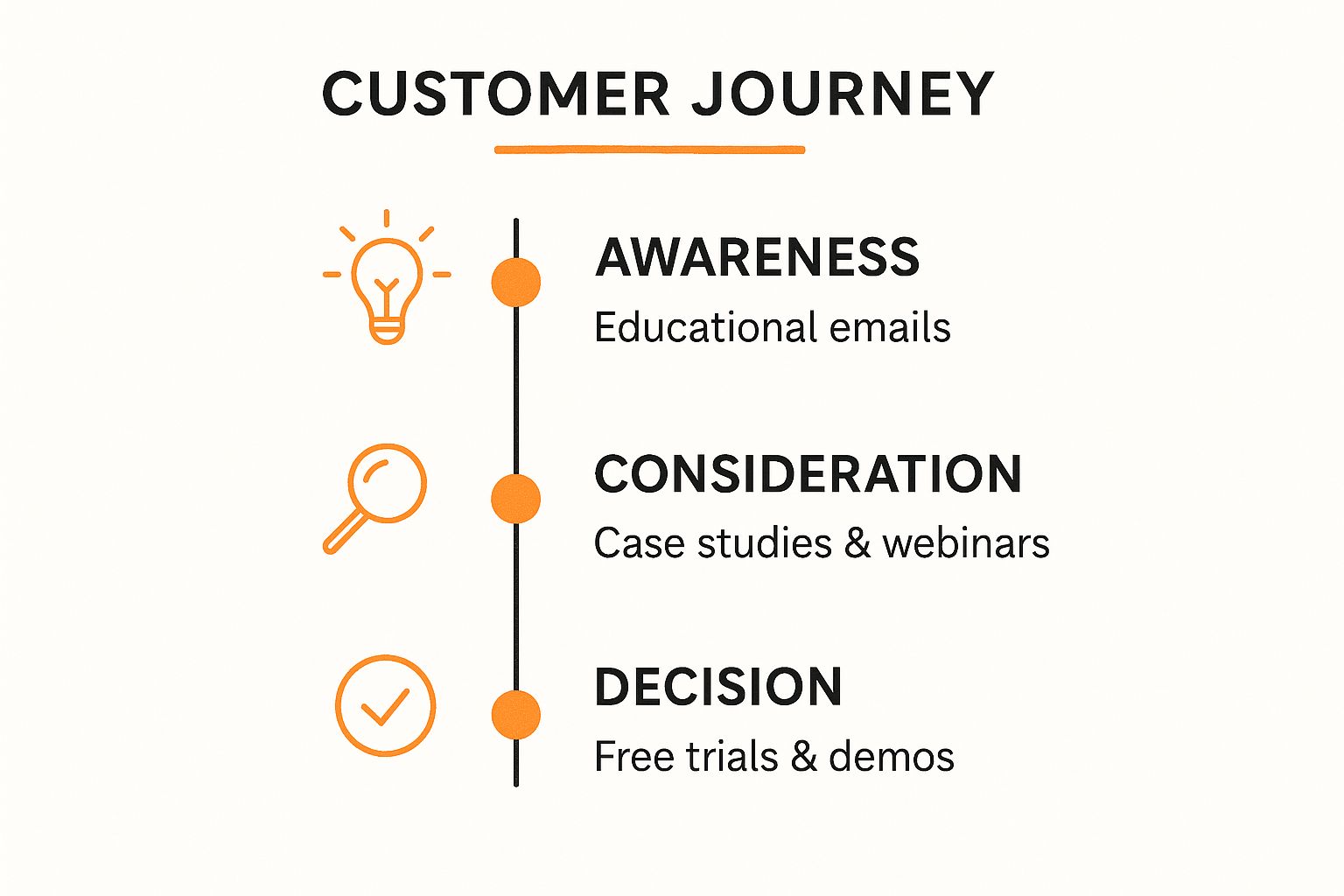
Journey mapping means aligning your drip emails with where someone actually is in their decision process. Awareness. Consideration. Decision. Each stage needs different content.
Someone who just learned about you needs education, not a sales pitch. Someone comparing you to competitors wants case studies and pricing. Match the message to the moment.
Why This Matters
Asking for a demo in your first email is like proposing marriage on a first date. Calm down.
Grammarly nails this. Their free users get tips on using the tool before anyone mentions the premium version. They earn the right to sell by proving value first.
Shopify's onboarding drip doesn't just say "welcome." Each email guides users through the next logical step: set up your store, add your first product, make your first sale.
How to Implement Journey Mapping
Define your stages. Map out the path your customers actually take. Talk to real customers. Look at your data. Typical stages: Awareness, Consideration, Decision, Retention, Advocacy.
Follow the 80/20 rule. For early-stage drips, 80% educational content, 20% promotional. Flip that ratio too early and you'll lose them.
Match your CTAs to the stage. Awareness stage: "Download the guide." Decision stage: "Start your free trial." Simple, but most people get this wrong.
Build branching logic. If someone clicks a link about Feature X, send them more content about Feature X. If they ghost you, trigger a re-engagement sequence.
3. Establish Strategic Timing and Frequency
Send too often, people unsubscribe. Send too rarely, they forget you exist.
Finding the timing sweet spot is one of the highest-leverage things you can do. It's also where most marketers screw up.
SaaS onboarding? Maybe every 3-5 days to match product adoption pace. Abandoned cart recovery? You've got hours, not days, to get that sale back. Context matters.
The Cost of Getting This Wrong
Send an email too soon after the last one and you look desperate. Wait too long and you've lost momentum. Neither is a good look.
Warby Parker sends their first welcome email immediately, then follows up every 3-4 days with brand stories and style guides. Not aggressive, not absent. Just consistent.
Getting timing right also affects your email deliverability. Spam complaints from over-mailing tank your sender reputation fast.
Timing Tips That Work
| Campaign Type | First Email | Follow-up Interval | Notes |
|---|---|---|---|
| Abandoned Cart | Within 1 hour | 24 hours, then 72 hours | Urgency matters |
| Welcome Series | Immediately | Every 2-3 days | Build relationship fast |
| Lead Nurture (B2B) | Day after signup | 7-10 days | Longer sales cycles |
| Re-engagement | After 30-60 days inactive | Weekly for 3 emails | Then sunset them |
| Post-Purchase | Day after delivery | Weekly for 4 weeks | Maximize lifetime value |
Test off-peak times. Early morning (6-7 AM) and evening (7-9 PM) often have less competition. Your email might actually get seen.
Set a global frequency cap. Limit how many marketing emails someone gets per week, regardless of how many campaigns they're in. This prevents accidental overload.
4. Craft Compelling Subject Lines and Preview Text
The best email in the world means nothing if nobody opens it.
Your subject line and preview text are the bouncers. They decide who gets in. Get these wrong and your click rates, your conversions, your whole funnel suffers.
Think of subject lines as headlines. You've got maybe two seconds to earn the click.
What Makes People Open
In a sea of "Newsletter #47" and "Weekly Update," specificity wins.
Grammarly's subject line: "You were more productive than 85% of Grammarly users." That's specific. That's personal. That gets opened.
For abandoned cart emails, "[Name], did you forget something?" outperforms generic "Your cart is waiting" messages every time. See our abandoned cart subject line guide for more examples.
Subject Line Formulas That Convert
Front-load the value. Mobile truncates after 40-50 characters. Put the good stuff first.
Use numbers. "7 tips to boost conversions" beats "Tips for boosting conversions" every time. Numbers promise specific, actionable content.
A/B test before full send. Test two subject lines on 15% of your audience. Send the winner to the rest. Simple but powerful.
Make preview text count. Don't repeat the subject line. If your subject is a question, hint at the answer in the preview text.
5. Prioritize Value-Driven Content Over Promotional Messages
Nobody wakes up excited to be sold to.
The brands that win at drip marketing treat most of their emails as gifts, not asks. Education. Entertainment. Solutions to real problems. Then, when they do sell, people actually listen.
Call it the 80/20 rule: 80% value, 20% promotion. You earn the right to pitch by helping first.
Why Value-First Wins
Constant promotional emails lead to unsubscribes. Valuable emails build anticipation.
Moz sends educational "Whiteboard Friday" videos for months before ever pitching their SEO tools. When they do pitch, their audience trusts them.
A SaaS company can teach users how to solve a problem, then position their software as the ultimate solution. The product becomes an investment in a goal they're already pursuing.
Making This Work
Build a content bank. Repurpose your best blog posts, case studies, and webinar clips into email-friendly formats. Organize by journey stage.
Ask what they want. Survey your subscribers about their biggest challenges. Then build drip content that answers those questions directly.
Make every email actionable. Even educational emails should include a specific takeaway or small step readers can implement today.
Frame promotions as solutions. When you do sell, connect the offer to problems you've been helping them solve. It becomes the logical next step.
6. Implement Behavior-Based Triggers and Automation
Time-based drips are fine. Behavior-based drips are better.
The difference: time-based sends Email 3 on Day 7 regardless of what happened. Behavior-based sends the next email when someone takes a specific action, like viewing your pricing page or clicking a particular link.
This makes your emails feel less like marketing and more like a conversation. Because they're responding to what people actually do.
Real Examples of Behavior Triggers
Amazon's browse abandonment emails: you look at a product, leave without buying, and get an email featuring that exact product. It's a direct response to your behavior.
Duolingo pings you when you miss a practice session. They use inactivity as a trigger to pull you back in.
Both are way more effective than generic scheduled newsletters.
Setting Up Behavior Triggers
Start with high-impact triggers. Welcome email for new subscribers. Cart abandonment sequence. Purchase confirmation. These deliver immediate returns.
Set frequency caps. Don't let one browsing session trigger five emails. One behavioral trigger per action, maximum.
Use negative triggers. Remove someone from your cart abandonment sequence the moment they complete purchase. Obvious, but lots of companies mess this up.
Layer triggers with segments. A content download follow-up for a new subscriber should differ from one for a repeat customer.
7. Optimize for Mobile Devices
Over 41% of emails get opened on mobile. If your drips look terrible on a phone, you're losing almost half your audience before they even read a word.
Mobile optimization isn't just about readable text. It's responsive layouts, fast load times, and buttons big enough to actually tap.
What Happens When You Ignore Mobile
An email that requires pinching and zooming to read tells subscribers you don't care about their experience. Most will delete it and move on.
Starbucks designs their drip emails with large images and fat "Order Now" buttons perfectly sized for thumbs. Headspace uses vertical layouts and simple navigation. Both work beautifully on small screens.
Mobile Optimization Checklist
Design mobile-first. Don't shrink a desktop design. Start with mobile and expand up. Forces you to prioritize what matters.
Use single-column layouts. They work everywhere. No horizontal scrolling, no broken layouts.
Keep subject lines under 30 characters. Prevents truncation on mobile email clients.
Make buttons thumb-friendly. Big enough to tap accurately. At least 10px spacing around links so people don't accidentally click the wrong thing.
Test on real devices. Preview tools are fine, but nothing beats seeing your email on an actual iPhone and Android device.
8. Test, Measure, and Continuously Optimize Performance
Your first version is never your best version.
The marketers who consistently win treat every drip campaign as a hypothesis. They test. They measure. They improve. Then they do it again.
This is how you compound small gains into significant results over time.
The Power of Systematic Testing
The 2012 Obama campaign raised an extra $500 million largely through email A/B testing. They discovered that simple subject lines like "Hey" outperformed polished alternatives by a huge margin.
HubSpot found that personalized CTAs convert 202% better than generic ones. But they only discovered this by testing.
For a deeper look at what to measure, check out our guide on email marketing performance metrics.
A Testing Framework That Works
Test one thing at a time. Change the subject line OR the CTA, not both. Otherwise you won't know what caused the difference.
Prioritize high-impact elements. Subject lines, CTAs, offers, and send times. These move the needle most.
Wait for statistical significance. Don't declare winners too early. You need at least 1,000 opens or clicks per variation for reliable data.
Document everything. Keep a log of what you tested, your hypothesis, the results, and what you learned. This becomes your playbook.
Putting It All Together
Effective drip campaigns are conversations, not broadcasts.
They respond to what subscribers actually do. They deliver value before asking for anything. They show up at the right time with the right message. And they get better over time through relentless testing.
Here's your action plan:
Start with segmentation and journey mapping. These are foundational. Without knowing who you're talking to and what they need, everything else falls flat.
Add behavior triggers. Upgrade from purely time-based to responsive sequences. Even adding cart abandonment and browse abandonment triggers will boost results.
Commit to optimization. Your first drip isn't your final drip. Test subject lines, timing, content. Keep refining. The gains compound.
Stop treating email automation like a set-and-forget checkbox. Treat it like what it is: a direct line to revenue that rewards attention and effort.
Want help building drip campaigns that actually perform? The team at Inbox Connect builds and manages high-converting email sequences for growing brands. Book a free 30-minute email audit at Inbox Connect and get an actionable roadmap for your list.