Marketing automation sounds complicated. It sounds expensive. It sounds like something only companies with a 12-person marketing team and a six-figure tech stack can pull off.
It's none of those things. Not even close. For the full playbook, see our marketing automation best practices guide. Start with email automation - it's the highest-ROI automation for most small businesses. See our triggered emails guide for what to automate first.
At its core, marketing automation for small business is just this: setting up systems that send the right message to the right person at the right time. Automatically. Without you lifting a finger.
That welcome email to new subscribers? Automatic. That follow-up to someone who abandoned their cart? Automatic. That "we miss you" message to customers who haven't bought in 90 days? You guessed it.
You set it up once. It runs forever.
What Marketing Automation Actually Does For You
Here's the thing most people get wrong about automation.
They think it's about replacing themselves. About becoming less personal. About letting robots talk to their customers.
Wrong.
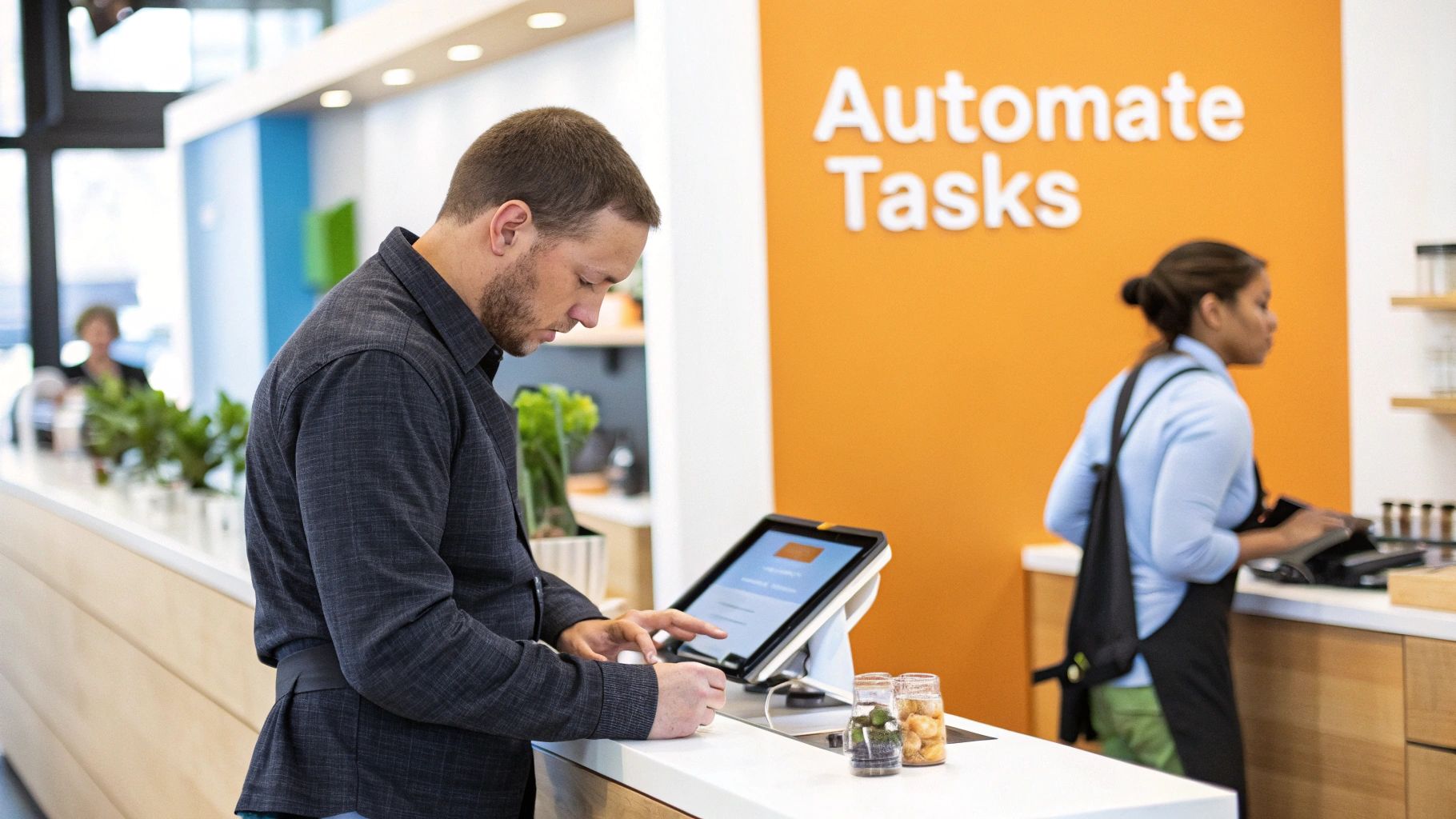
Automation is about consistency. It's about making sure every single person who interacts with your business gets a professional, timely response. Even when you're sleeping. Even when you're on vacation. Even when you're drowning in client work.
Think about all the repetitive tasks you do every week:
- Sending welcome emails to new subscribers
- Following up with leads who filled out a form
- Reminding customers about appointments
- Nudging people who didn't complete their purchase
- Re-engaging customers who've gone quiet
Every single one of those can run on autopilot.
The Numbers Don't Lie
The marketing automation market is projected to grow from $5.65 billion in 2024 to $14.55 billion by 2031. And a massive chunk of that growth is coming from small businesses finally realizing they don't need a Fortune 500 budget to compete.
Here's what the data actually shows:
| Metric | Impact |
|---|---|
| Sales productivity increase | 14.5% |
| Marketing cost reduction | 12.2% |
| Lead generation improvement | 18% |
| Manual task reduction | 25% |
Those aren't hypothetical numbers. Those are real results from businesses that stopped doing everything manually.
Before You Touch Any Software
Stop. Don't sign up for anything yet.
The biggest mistake I see small business owners make with automation? They buy a tool first, then try to figure out what to do with it.
That's backwards.
Before you look at a single platform, you need to answer one question: What specific problem am I trying to solve?
Maybe it's this: "I'm losing leads because I can't follow up fast enough."
Or this: "I'm leaving money on the table from abandoned carts."
Or maybe: "I spend 5 hours a week on emails I could automate."
Get specific. Write it down. That problem becomes your first automation project.
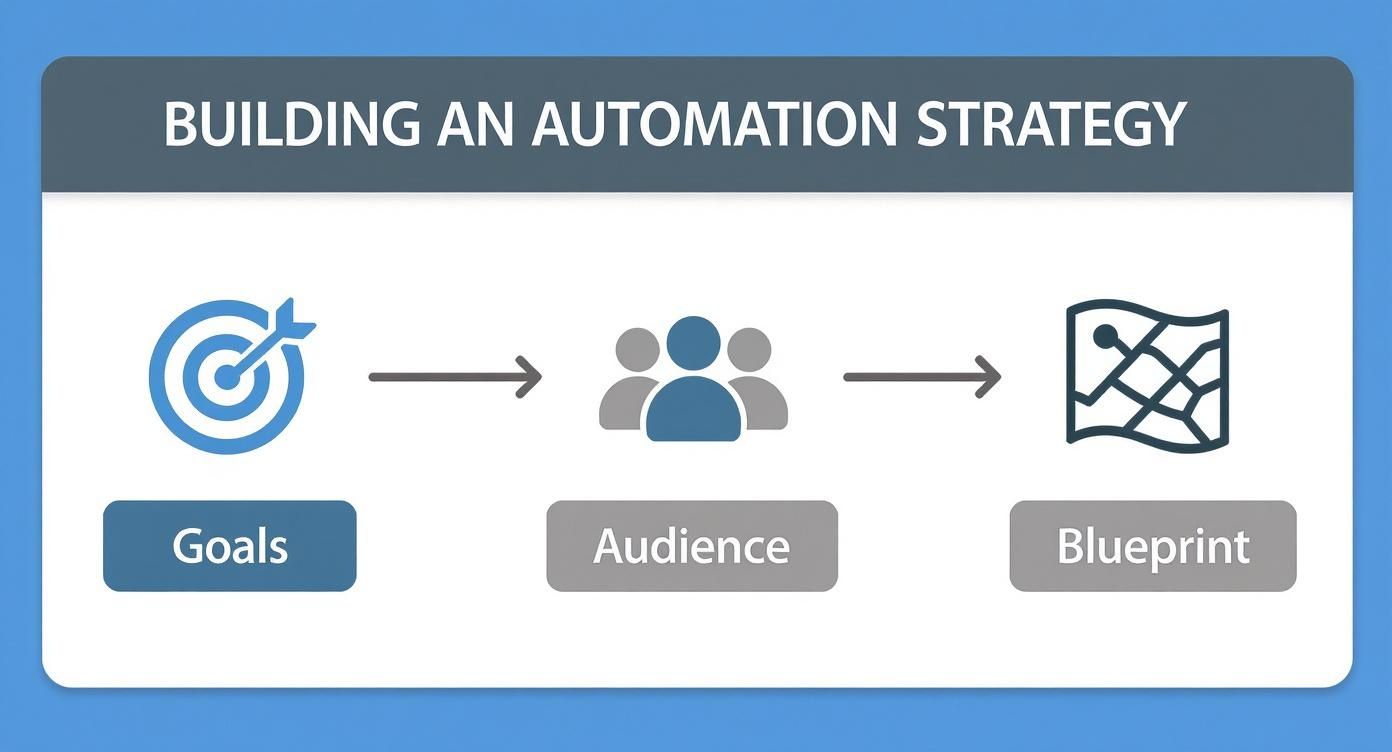
Map Your Customer Journey
Here's a simple exercise that will make everything clearer.
Grab a piece of paper. Draw the path someone takes from first hearing about you to becoming a loyal, repeat customer.
Where does someone first find you? Your website? Social media? A referral?
What do they do next? Sign up for your email list? Fill out a contact form? Make a purchase?
What happens after that first interaction? Do they hear from you again? When? How?
This map shows you exactly where to put automated messages. A new subscriber needs a welcome email immediately, not a week later. Someone who just bought needs a thank-you and maybe some tips for using their purchase. A customer who hasn't bought in 90 days needs a nudge.
Each touchpoint is an opportunity for automation to do the heavy lifting.
For a deeper dive into planning your email strategy, check out our guide on drip campaign best practices for maximum ROI.
The Three Workflows Every Small Business Needs
Here's where we get practical.
You don't need 50 automations running. You need three. At least to start.
Get these right, and you'll cover 80% of the value automation can provide. You can always add more later.
Workflow 1: The Welcome Series
Your first impression matters more than any other email you'll ever send.
When someone joins your list, they're interested right now. They're paying attention right now. If you wait a week to reach out, you've already lost them.
A welcome series is a sequence of 3-5 emails that go out automatically over the first week or two after someone subscribes. Here's a simple structure:
Email 1 (immediately): Thank them for joining. Deliver whatever you promised (discount, guide, etc.). Set expectations for what they'll receive from you.
Email 2 (day 2): Share your story. Why did you start this business? What makes you different? People buy from people they connect with.
Email 3 (day 4): Provide pure value. A tip, a resource, something helpful with no ask attached.
Email 4 (day 7): Soft pitch. Now that you've provided value, it's okay to invite them to take the next step.
Welcome emails have a 25% higher open rate than regular newsletters. That's your best chance to make an impression. Don't waste it.
For more on nailing that first impression, read our guide on email onboarding best practices to boost engagement.
Workflow 2: Abandoned Cart Recovery
This one is money in your pocket. Literally.
Nearly 70% of online shopping carts get abandoned. Think about that. Seven out of ten people who add something to their cart just... leave.
Most of them aren't gone forever. They got distracted. They wanted to think about it. They got interrupted by their kid or their boss or their cat.
An abandoned cart sequence brings them back.
Message 1 (1 hour after abandonment): "You left something behind." Show them exactly what's in their cart. Keep it simple and friendly.
Message 2 (24 hours): Add urgency. "Your cart is waiting." Maybe mention limited stock if applicable.
Message 3 (48-72 hours): Offer an incentive. A small discount, free shipping, something to push them over the edge.
Pro tip: Don't just use email. Add an SMS reminder in there. Text messages have a 98% open rate. Sometimes a quick "Still thinking it over?" is all someone needs.
For subject line ideas that actually work, check out our piece on abandoned cart email subject lines.
Workflow 3: The Win-Back Campaign
Customers go quiet. It happens.
Maybe they found a competitor. Maybe they just forgot about you. Maybe their needs changed temporarily.
A win-back campaign reaches out to customers who haven't purchased in a set period, usually 60-90 days.
Email 1: "We miss you." Remind them what you offer. No discount yet.
Email 2 (3-5 days later): Offer an incentive. 10-15% off their next purchase. Free shipping. Something meaningful.
Email 3 (7 days later): Last chance. Make it clear this is the final offer. Create some urgency.
The key is triggering this automatically. You set the rules once: "If a customer hasn't purchased in 90 days, start this sequence." Then it runs forever, constantly working to bring back lapsed customers.
For more on lifecycle strategies, check out our guide on customer lifecycle marketing.
Choosing the Right Tool (Without Overspending)
Here's where a lot of small business owners get tripped up.
They see enterprise tools like HubSpot or Marketo and think "I can't afford that." Then they either give up or settle for something basic that doesn't actually do what they need.
The truth? There are great automation platforms built specifically for small businesses. Many have free tiers or very affordable entry points.
What Actually Matters in an Automation Tool
Forget the fancy features. Focus on these non-negotiables:
Visual workflow builder. You should be able to see your automation as a flowchart. If you need to write code or understand complex logic, keep looking.
Email AND SMS. Being able to mix channels in the same workflow is powerful. An email followed by a text message is more effective than either alone.
Clean contact management. You need to segment your audience based on their behavior. "New subscribers" should get different messages than "repeat customers."
Reliable deliverability. The best automation in the world is worthless if your emails land in spam. Look for platforms with good sender reputations.
How to Actually Decide
Here's my suggestion.
Pick 2-3 platforms that fit your budget. Sign up for free trials. Then try to build your welcome series on each one.
The right platform will feel intuitive. You'll be able to create your first workflow without watching 10 tutorial videos.
The wrong platform will have you frustrated within 20 minutes.
Trust that frustration. If it's hard now, it'll be hard later.
Measuring What Matters
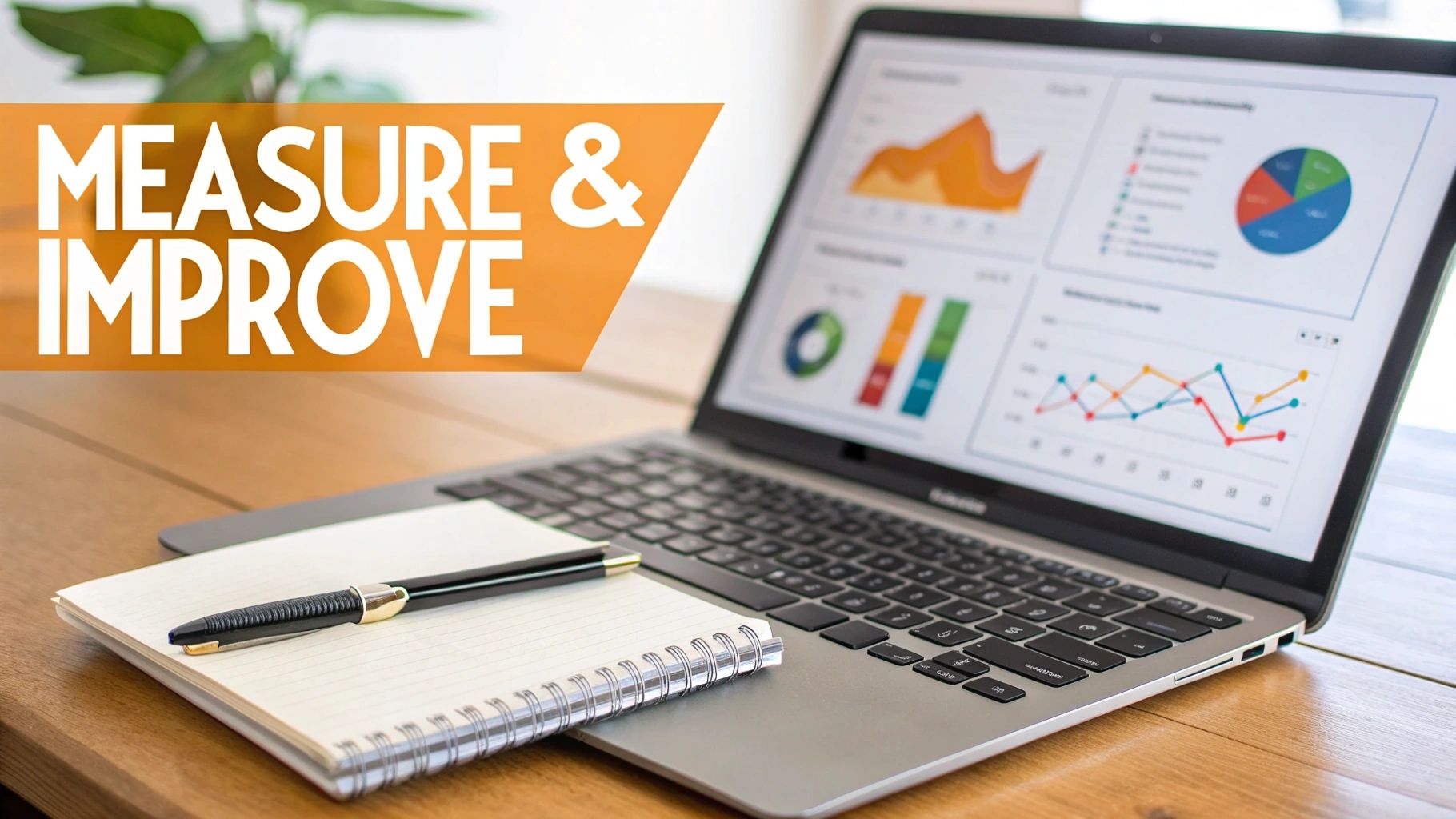
Setting up automation is step one. Knowing if it's working is step two.
Good news: your automation platform tracks everything. You don't need to build spreadsheets or hire an analyst.
But you do need to know which numbers actually matter.
The Metrics That Tell You Something Useful
Open Rate
This tells you if your subject lines are working. If people aren't opening, nothing else matters.
Benchmark: Aim for 20-25% for general emails, 40%+ for automated sequences like welcome emails.
Click-Through Rate (CTR)
Of the people who opened, how many clicked something? This tells you if your content is engaging and your calls-to-action are compelling.
Benchmark: 2-5% is solid. Anything above 5% means your content is really resonating.
Conversion Rate
The only metric that truly matters for revenue. Of the people who clicked, how many actually did the thing you wanted? Bought something, signed up, booked a call?
This is where you see the real ROI of your automation.
For a complete breakdown of what to track, read our guide on key email marketing performance metrics.
The Testing Mindset
Here's where automation gets interesting.
Once you have workflows running, you can start testing. Change a subject line. Swap out an image. Try a different offer.
The beauty of automation is you can test one variable at a time and see exactly what impact it has. Over months of small improvements, your results compound.
A 10% improvement in open rate. A 15% improvement in click rate. A 20% improvement in conversion rate. Stack those together and you've doubled your results from the same traffic.
Common Questions Answered
Let me tackle the three questions I hear most often from small business owners.
"Is this too expensive for me?"
Probably not.
Yes, there are enterprise platforms that cost thousands per month. But there are also excellent options with free tiers or plans starting at $10-20/month.
More importantly, think about the return. If an abandoned cart sequence recovers even one extra sale per week, the tool probably pays for itself.
Automation isn't an expense. It's your biggest force multiplier.
"How long does this take to set up?"
Your first workflow can be live this afternoon.
Seriously. A basic welcome email sequence takes maybe 2-3 hours to write, design, and set up. Less if you start with a template.
The key is starting simple. Don't try to build a 47-step workflow with 15 conditional branches. Start with a linear sequence of 3-4 emails. Get that working. Then expand.
"Do I need to be technical?"
Not even a little bit.
Modern automation platforms are designed for business owners, not developers. Everything is drag-and-drop. If you can write an email, you can build an automation.
And if you get stuck? Every platform has tutorials, knowledge bases, and customer support. You're not on your own.
Getting Started This Week
Here's your action plan:
Day 1: Decide on your first workflow. I'd recommend the welcome series since it applies to almost every business.
Day 2: Sign up for a free trial of 2-3 automation platforms. Don't overthink this step.
Day 3-4: Write your email content. You need 3-4 emails for a welcome series. Draft them in a Google Doc first.
Day 5: Build the workflow in whichever platform felt easiest. Set your triggers, add your emails, test it.
Day 6: Go live. Send yourself a test email. Check that everything looks right on mobile. Then turn it on.
Day 7: Move on to your second workflow.
That's it. One week to get your first automation running. One week to stop doing something manually that you'll never have to do manually again.
The Bottom Line
Marketing automation isn't complicated. It isn't just for big companies. And it isn't optional anymore.
Every day you spend manually sending emails, following up with leads, and trying to remember who you need to reach out to is a day your competitors are spending on growth.
The tools are affordable. The learning curve is minimal. The ROI is proven.
The only question is whether you're going to start this week or keep putting it off.
Need help getting your automation set up right the first time? The team at Inbox Connect specializes in building email systems that generate revenue on autopilot. Book a free 30-minute audit and we'll identify the highest-impact automations for your specific business.