
Beehiiv wins when the newsletter is the business. Substack wins when you need free discovery and paid writing. Kit wins when you sell digital products through email funnels.
You are comparing beehiiv vs Substack vs Kit because every landing page claims growth, and none of them tell you who loses. This guide picks a winner and a stated loser by use-case, with October 2026 pricing, deliverability notes, recommendation networks, and paid features you can actually use.
We also cover MailCheap as a send-priced indie option, plus the public Marc Lou vs Tyler Denk discourse around it, because that fight is part of how people are shopping this category right now.
If you still need the strategy behind the send, start with newsletter strategy. For a wider ESP shortlist beyond these three, see best email marketing platforms.
tl;dr
- Media newsletter with ads, paid tiers, and a branded site: beehiiv wins. Substack loses.
- Writer who wants app discovery and zero monthly fee: Substack wins. Kit loses.
- Creator selling courses, tips, or digital products with automations: Kit wins. Substack loses.
- Cost-obsessed indie who will trade media features for send-based pricing: MailCheap is worth a look. It is not the media-business winner.
- Prices below are monthly USD from each vendor's public pricing or help pages, checked October 26, 2026. Confirm the slider in your own account before you budget.
- Inbox Connect builds and runs beehiiv programs for brands that treat the list as a growth asset. That shapes the media-business call below, and it does not mean every reader should buy beehiiv.
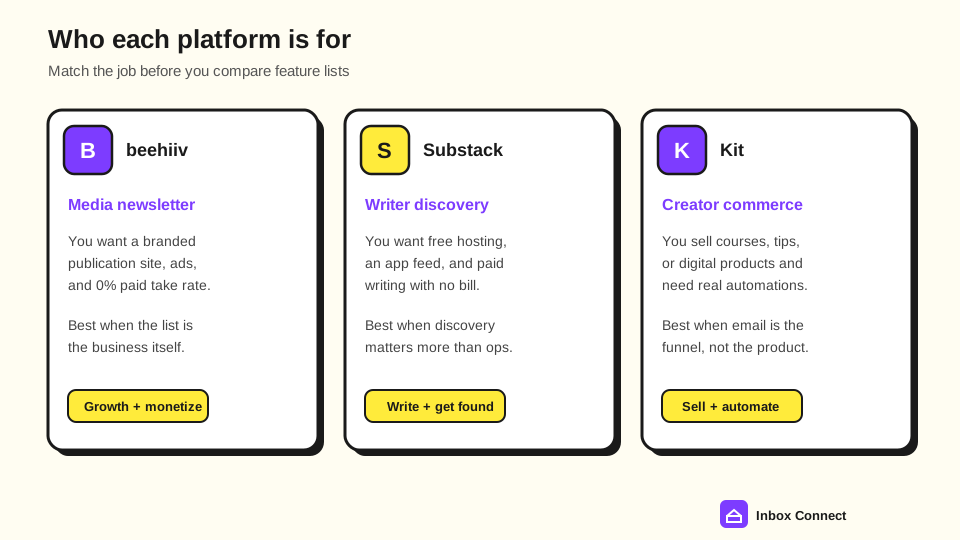
Who each is for
beehiiv, Substack, and Kit are not three flavors of the same product. They hire for different jobs, and picking the wrong one costs you months of migration later.
beehiiv
beehiiv is for operators who want a newsletter that looks and behaves like a media property. You get a website builder, recommendation network, ad network on paid plans, paid subscriptions at a 0% platform take rate, and automations once you leave Free (beehiiv pricing).
Choose beehiiv when the list is the asset, sponsors matter, and you want brand control without living inside someone else's app feed.
Free covers up to 2,500 subscribers with unlimited sends. Lite and Pro then price by list size.
Substack
Substack is for writers who want publishing, discovery, and paid subscriptions with no monthly platform bill. You publish free forever.
When readers pay, Substack keeps 10% of each subscription payment and Stripe takes card and billing fees (Substack Help Center).
Choose Substack when the Substack app, Notes, and recommendation network will find you readers faster than your own SEO. Skip it when you need deep automations, a custom commerce stack, or a site that does not feel like Substack.
Kit (formerly ConvertKit)
Kit is for creators who sell. Free covers up to 10,000 subscribers with broadcasts, forms, landing pages, and product sales.
Automations and sequences need Creator, which starts around $39 per month billed monthly at smaller list sizes (Kit pricing).
Choose Kit when email is the funnel for courses, coaching, tip jars, or paid newsletters, and you need visual automations that branch. Kit is weaker as a publication site and discovery network than beehiiv or Substack.
MailCheap (worth including, not forced as winner)
MailCheap (mailcheap.ai) is Marc Lou's open-source newsletter platform with a hosted cloud from $19/month. You pay for emails sent and subscriber caps on each plan, not a beehiiv-style list ladder alone (MailCheap plans).
At 4,000 subscribers sending once a week, MailCheap's own math puts Starter at $19 versus beehiiv Lite at $109 (prices they published for October 2026). Self-hosting on Amazon SES or PostShiba is free software plus your provider bill.
Choose MailCheap when the job is cheap, clean sending with built-in warmup, list cleanup, and agent/API control. Do not choose it yet if you need beehiiv's ad network, recommendation marketplace, or a battle-tested media ops stack for a legacy brand.
How we score beehiiv vs Substack vs Kit
Feature grids all look identical after the first scroll. We score these five instead.
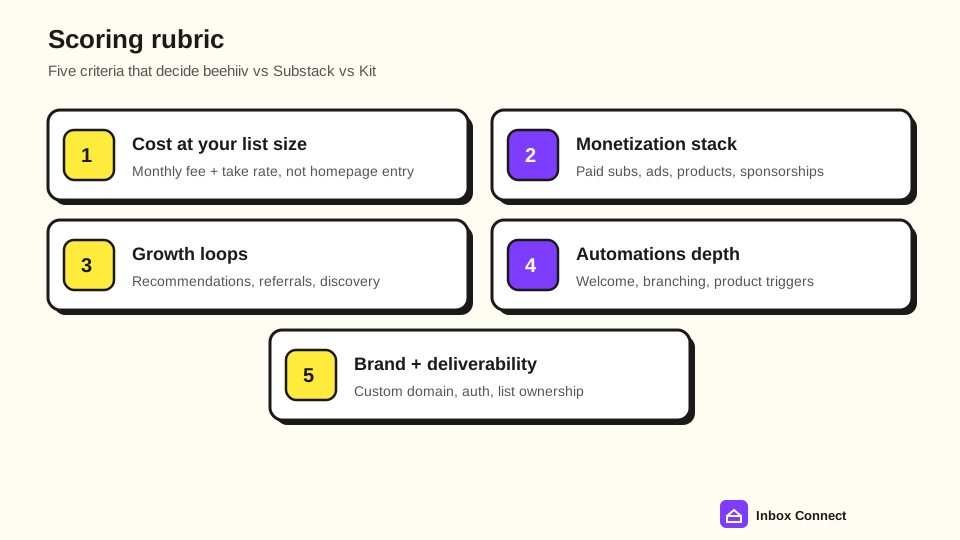
Cost at Your List Size: Entry pricing is marketing. We look at the monthly bill at 1,000 and 10,000 subscribers, plus platform take rates on paid revenue.
Monetization Stack: Paid subscriptions, ads, digital products, and sponsorship matching are not equal. A 0% take rate beats a pretty checkout that keeps 10% forever.
Growth Loops: Recommendations, referrals, and in-app discovery decide who grows without paid ads. A free plan with a strong network can beat a paid plan with none.
Automations Depth: Welcome emails are table stakes. Branching sequences, product triggers, and click-based paths are where creators outgrow Substack and Free beehiiv.
Brand and Deliverability: Custom domains, authentication, list export, and how much of the experience lives on your brand versus the platform's app.
Inbox Connect scores tools the same way we pick stacks for clients. Pretty templates lose to honest cost and growth math every time.
Pricing: beehiiv vs Substack vs Kit in 2026
The comparison that matters is the bill at your real list size, plus what each platform keeps when you earn.
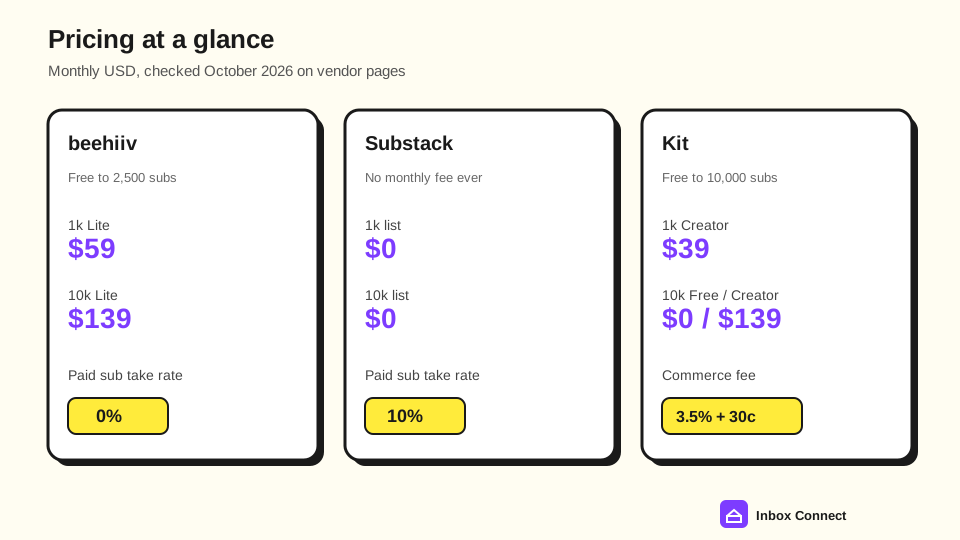
Figures below are monthly USD for the cheapest plan that still covers normal publishing at that size. Kit Free still works at 10,000 for broadcasts. Creator is listed separately because that is where automations live.
| Platform | Free plan | ~1,000 subs | ~10,000 subs | Cut of paid revenue | Custom domain |
|---|---|---|---|---|---|
| beehiiv | Up to 2,500 | Lite $59/mo ($49/mo yearly) | Lite $139/mo ($119/mo yearly) | 0% (Stripe fees apply) | Paid plans |
| Substack | Unlimited, $0 | $0 | $0 | 10% + Stripe fees | $50 one-time |
| Kit | Up to 10,000 | Free $0 / Creator ~$39/mo | Free $0 / Creator ~$139/mo | 3.5% + $0.30 on commerce (card fees included) | Landing pages |
| MailCheap | No free trial; self-host free | Starter $19/mo (20k emails / 10k subs) | Same Starter until you exceed email or sub caps | N/A (sending product) | Paid cloud or self-host |
beehiiv's Free plan ends at 2,500 subscribers. Lite at 1,000 is $59 monthly or $49 when billed yearly.
At 10,000 it is $139 monthly or $119 yearly, per beehiiv's pricing page as of October 2026.
Substack stays at $0 until you turn on paid subscriptions. At $4,000 a month in paid revenue, Substack's 10% alone is $400 before Stripe. That is more than beehiiv Lite costs at 10,000 subscribers.
Kit's Free plan is generous on list size. You pay when you need Creator automations, or when commerce fees stack on digital product sales.
Confirm Creator pricing on kit.com/pricing for your exact subscriber bucket, because the slider moves.
MailCheap Starter is $19 for 20,000 emails and 10,000 subscribers, then Growth $39, Pro $79, and higher tiers up the email and subscriber caps (MailCheap plans, checked 26 Oct 2026). That is a send-and-cap bill, not a media monetization suite.
Pro tip: Model three scenarios on a napkin: free list only, paid subscriptions at 5% of the list, and product sales. The cheapest free plan often loses once money starts moving.
Deliverability
All three can land in the inbox when you authenticate properly and keep the list clean. None of them will save a cold list you bought last year.
beehiiv markets optimized deliverability on every plan and adds dedicated IPs on Enterprise (beehiiv pricing).
You still need SPF, DKIM, and DMARC on your sending domain, plus a sunset path for unengaged subscribers.
Substack manages delivery infrastructure for you, which is part of why writers stay. You export the list when you leave, but day-to-day reputation lives inside Substack's pool. That is fine until you want custom sending domains and deeper control.
Kit includes deliverability reporting on higher plans and has long experience with creator broadcasts. Like beehiiv, you own authentication and list hygiene. If you resend to unengaged segments forever, Kit cannot outrun spam complaints.
Across all three, the boring work wins: double opt-in when it fits, prune hard bounces, and stop mailing people who never open. For the wider hygiene playbook, pair this with your sender reputation process rather than blaming the ESP.
MailCheap publishes live delivery stats on mailcheap.ai/open. As of their 30-day window ending 25 Oct 2026, they showed about 99.3% delivery, 0.6% hard bounces, and 0.045% spam complaints, with paced warmup and complaint pauses built in. That is encouraging for a young product. It is still a short track record next to beehiiv's infrastructure claims.
Recommendations and referrals
Growth loops are why this three-way fight exists. A platform with a network can replace months of cold outreach.
beehiiv ships a recommendation network on Free, then paid recommendations and referral milestones on Lite and up (beehiiv pricing).
Other publications can send you subscribers for free or for a paid boost. Referral rewards give your readers a reason to share.
Substack's discovery engine is the main reason writers start there. Recommendations, the Substack app, Notes, and social proof inside the network create inbound that a standalone site rarely matches on day one. You trade brand independence for that distribution.
Kit offers paid recommendations and a newsletter referral system on higher plans. It is useful for creator cross-promotion, but it is not a consumer reading app the way Substack is. Treat Kit recommendations as a monetization and partner tool, not a discovery feed.
If your growth plan is "get found by strangers scrolling," Substack leads. If your growth plan is "trade subscribers with other newsletters and run referral milestones on a branded site," beehiiv leads. Kit sits in the middle for creators who already have an audience elsewhere.
Paid features and monetization
This is where the platforms stop looking alike.
beehiiv paid features
Lite adds the ad network, paid recommendations, 0% take rate on paid subscriptions, digital products, automations, surveys, and webhooks.
Pro adds remove branding, more publications, dynamic content, click-triggered automations, sponsorship storefront, and higher team limits (beehiiv pricing).
That stack is why we pick beehiiv for media-style newsletters. You can earn from ads, paid tiers, and boosts without giving the platform a permanent cut of subscriptions.
Substack paid features
Substack's paid product is the subscription itself: monthly, annual, and founding member tiers, gifts, trials, and group billing. There is no monthly platform fee. The cost is the 10% forever, plus limited automation depth and no public API comparable to beehiiv or Kit.
You win on simplicity. You lose when you need commerce beyond the paywall or a white-label experience.
Kit paid features
Kit sells digital products, paid newsletters, tip jars, and recurring memberships with an all-in commerce fee listed around 3.5% + $0.30.
Creator adds visual automations, sequences, and RSS campaigns. Higher tiers add deliverability reporting, engagement scoring, and priority support (Kit pricing).
Kit wins when checkout and email sequences are the product. It loses when you need a publication-first site with an ad network.
Marc Lou, Tyler Denk, and the MailCheap beef
October 2026 turned a pricing complaint into a public founder fight, and it belongs in this comparison because buyers are using it as signal.
Marc Lou (@marclou) left beehiiv after repeated price increases, vibe-coded a newsletter stack, open-sourced it, then launched MailCheap hosted from $19/month with an 83% cheaper claim versus beehiiv Lite at 4,000 weekly subscribers (MailCheap launch thread; product site math checked October 2026).
Tyler Denk (@denk_tweets), beehiiv's CEO, answered the "weekend clone" wave with a long backlog of what real email platforms must cover, starting with industry-leading delivery and deliverability staffing (Denk backlog post). Days later he posted a newsletter excerpt aimed at Marc, asking if he missed anything (Denk excerpt post), and linked the full Big Desk Energy issue "Built different".
Marc's replies stayed short. One marked Tyler's issue as "not spam" to "help" deliverability (Marc reply).
Another jabbed at support speed with screenshots (Marc support jab). He also posted MailCheap usage milestones, including a quote of the "no one serious" line next to early volume (Marc volume post).
Writer's take
Marc has a real shot at greatness in email. The send-based pricing thesis is correct, the open-source angle is sharp, and shipping in public forces incumbents to answer.
Time will tell whether MailCheap becomes infrastructure people trust with a brand list, or stays an indie darling with a loud launch.
Do not switch to Marc's tool because you are a fanboy if you already run a legacy newsletter brand. beehiiv still wins when ads, recommendations, sponsor workflows, and a media-shaped product are the job. MailCheap wins the napkin math for lean senders who will own more of the ops themselves.
Treat the beef as context, not a buying committee.
Price pressure is healthy. Deliverability and support still decide whether your Monday send lands.
Stated losers by use-case
Here is the part most comparison posts dodge. We will not.
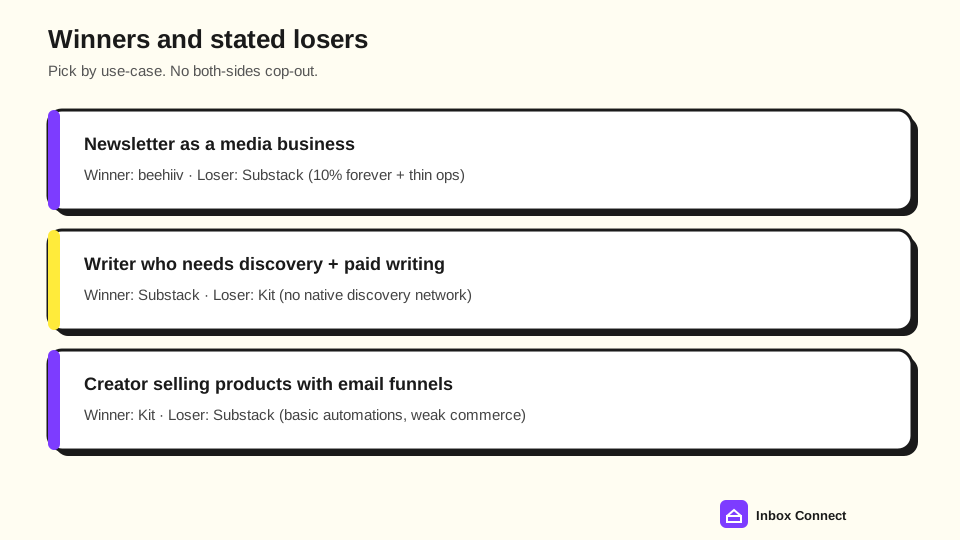
| Use-case | Winner | Stated loser | Why |
|---|---|---|---|
| Newsletter as a media business | beehiiv | Substack | 0% take rate, ads, branded site, automations on Lite |
| Writer discovery + paid writing, $0 monthly | Substack | Kit | App feed and recommendations beat creator ESP discovery |
| Creator commerce + email funnels | Kit | Substack | Automations and product checkout beat basic paywalls |
| Growing past 2,500 without paying yet | Kit Free | beehiiv Free | Kit Free goes to 10,000; beehiiv Free caps at 2,500 |
| Brand site + sponsor ads as primary revenue | beehiiv | Kit | Ad network and publication tooling beat product-first Kit |
| Lean send-priced newsletter, open to indie tooling | MailCheap | beehiiv (on price alone) | Send caps beat list ladders when you do not need ads/network |
| Legacy media brand with sponsors and ops debt | beehiiv | MailCheap | Do not fanboy-migrate off a working media stack yet |
Substack is the stated loser for media businesses. The 10% cut never goes away, automations stay thin, and your brand lives inside Substack.
That is a fair trade for a solo writer. It is a bad trade for a publication that wants sponsors, a custom site, and ops that scale.
Kit is the stated loser for writers who need discovery. Kit is excellent at selling to people you already have. It will not replace Substack's consumer network when you are starting from zero followers.
beehiiv Free is the stated loser if you need a free plan past 2,500. Kit Free covers 10,000. If your only constraint is list size and you refuse to pay, Kit Free wins that narrow fight.
MailCheap is the stated loser for legacy media brands that need the full beehiiv growth and monetization stack today. Price is not the same as fit. Keep MailCheap on the shortlist for lean senders; keep beehiiv when the newsletter is a media business.
Frequently asked questions
Is beehiiv better than Substack?
For a media-style newsletter with ads, paid tiers, and a branded site, yes. beehiiv takes 0% of paid subscriptions on Lite and up, while Substack keeps 10% (beehiiv pricing; Substack Help Center).
For a writer who wants free discovery inside an app, Substack is still better. Answer beehiiv vs Substack from the job, not from the loudest Twitter thread.
Is beehiiv better than ConvertKit (Kit)?
If the newsletter is the product and you want ads plus a publication site, beehiiv wins. If you sell courses and digital products through branching automations, Kit (formerly ConvertKit) wins.
beehiiv vs ConvertKit is really a media stack versus a creator commerce stack. Pick the job first.
Is Kit better than Substack?
For creator funnels and product sales, yes. For discovery and simple paid writing with no monthly fee, Substack wins and Kit loses.
Kit vs Substack only looks close on a feature grid. In practice, one is an ESP with commerce and the other is a writing network with email.
Which is cheapest at 10,000 subscribers?
Substack is $0 monthly. Kit Free is also $0 if you only need broadcasts. MailCheap Starter is $19 if you stay inside 20,000 emails and 10,000 subscribers. beehiiv Lite is $139 monthly ($119 yearly) at the 10,000 bucket.
Cheap flips when paid revenue and media features show up. Substack's 10% can outrun beehiiv's monthly fee once subscriptions scale. MailCheap stays cheap on sends, then loses when you need ads, recommendations, and publication tooling.
Should I leave beehiiv for MailCheap because of the Marc Lou vs Tyler Denk fight?
No, not by itself. Read the public posts, then score your job: media monetization and network growth versus lean send-priced publishing.
Marc's shot at greatness is real enough to watch. A legacy newsletter brand should not migrate as a fan gesture.
Can I migrate later?
Yes, all three let you export subscribers. Migration still costs DNS work, welcome-flow rebuilds, and a few weeks of deliverability caution.
Start where the next 12 months of growth will live, not where the signup button felt easiest.
Does Inbox Connect recommend beehiiv for everyone?
No. We recommend beehiiv for newsletter businesses that need growth and monetization tooling under one roof. We send creators with heavy product funnels to Kit, and writers who need network discovery to Substack.
Our beehiiv agency work exists because plenty of brands already picked beehiiv and need the program run well.
Pick your stack, then build it
You now have winners and losers by use-case, not another undecided feature grid. beehiiv for the media newsletter, Substack for discovery-led writing, Kit for creator commerce, MailCheap for lean send-priced indie stacks that can wait on media features.
If beehiiv is the fit and you want the welcome flows, referrals, and monetization set up without the trial-and-error quarter, talk to us on the beehiiv agency page. Bring your list size and how you plan to earn. We will tell you straight if beehiiv is the wrong buy.