How do you write a newsletter people actually finish? Lead with a specific promise, stick to one idea per issue, and structure every send as hook, body, then one clear ask.
Below, you'll get a writing craft playbook: the promise, issue structure, subject and preheader pairs, voice, an editing checklist, three annotated examples, and answers to the questions we hear most from founders and marketers.
This is about the words, not the layout. For templates and visual structure, see our newsletter template examples. For the bigger plan behind the send, pair this with newsletter strategy.
tl;dr
- Write one sentence that names who the newsletter is for, what each issue delivers, and when it arrives.
- Ship one idea per issue so readers can finish without skimming for the point.
- Structure every send as hook, body, then one CTA.
- Treat the subject line and preheader as a pair that finish each other.
- Edit for voice, cuts, and mobile before you hit send.
Define the promise before you write a word
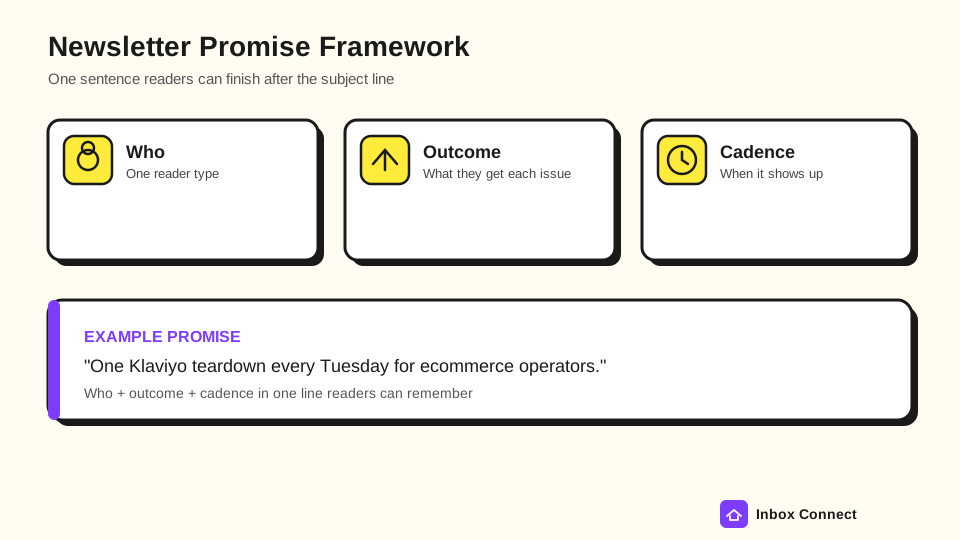
A newsletter promise is the one-sentence trade you make with the reader: who it's for, what they get, and how often. If you can't say that sentence out loud, the draft will wander, and so will your openers.
Why start here? Because every subject line, section, and CTA should prove the same promise. When the promise drifts, readers feel baited even if you meant well.
A strong newsletter promise usually includes three parts:
- Who: Name a real reader type, not "everyone interested in marketing."
- Outcome: Say what they leave with after each issue, such as a teardown, a checklist, or a curated set of links.
- Cadence: Tell them when it shows up so the habit can form.
Here are examples of newsletter promises that hold up in the inbox:
- Operator Teardown: "One Klaviyo flow teardown every Tuesday for ecommerce operators."
- Founder Field Notes: "A short founder lesson every Thursday for people shipping B2B products."
- Curator Brief: "Five worth-your-time links every Monday for growth marketers who hate noisy feeds."
Write the promise on a sticky note and keep it next to the draft. If a paragraph doesn't serve it, cut the paragraph (or save it for a different issue).
Pro tip: Put the promise in your signup copy and your welcome email. Readers who opt in for a clear trade forgive the occasional imperfect issue.
One idea per issue (yes, really)
The best way to write a newsletter that gets finished is to pick one idea and stop adding "just one more" section. Multi-topic dumps feel generous to the writer and exhausting to the reader.
You might be thinking your audience wants more value per send. What they usually want is a finished thought they can act on before the next meeting.
Use this filter when you're tempted to stuff the issue:
- Name the Idea in One Line: If you need two sentences to describe the point, you have two issues.
- Ask What the Reader Should Remember Tomorrow: Keep only the proof that supports that memory.
- Park Extra Ideas in a Backlog: Curated links and secondary tips can wait for a dedicated issue.
A useful length range for most operator newsletters is 400 to 900 words. Longer can work for a deep teardown, but only when the reader expects that depth and the structure stays scannable.
Beehiiv's 2025 State of Email Newsletters report, based on more than 15 billion emails sent in 2024, puts average open rates near 37.7% and click rates near 4.6%, and it urges senders to lean on clicks and engagement more than opens (beehiiv). Finishing the email is what creates those clicks and replies, so one clear idea beats a crowded table of contents.
Hook, body, CTA: the structure that gets finished
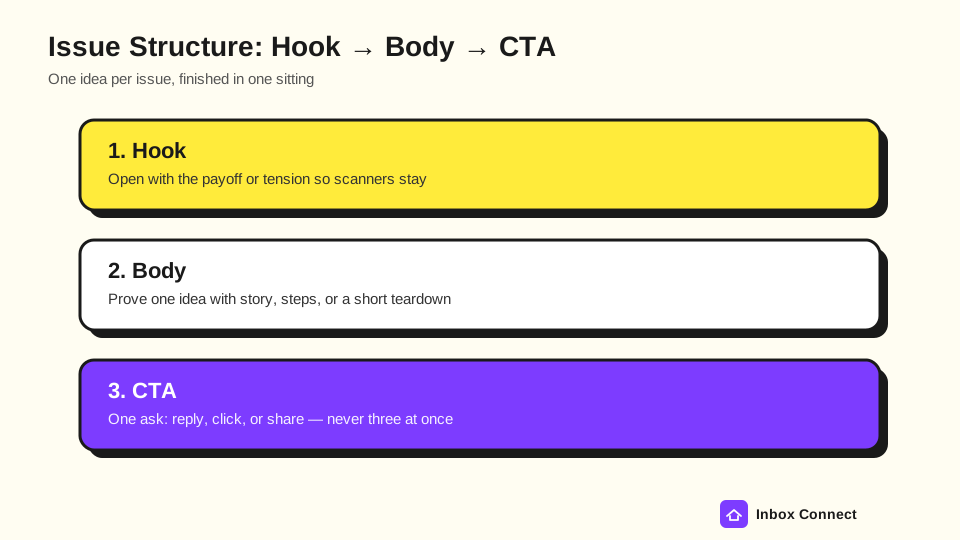
Every issue should move through three jobs: earn attention, deliver the idea, then ask for one action. That structure is how you write a newsletter people can complete in one sitting.
Hook
The hook is the first screen of the email, usually two to five short paragraphs. Open with the payoff, the tension, or a sharp observation so a scanner knows why this issue exists.
Weak hooks warm up with weather, apologies, or a long "this week I was thinking" windup. Strong hooks sound like the first useful line you'd say if the reader only had thirty seconds.
Body
The body proves the one idea with a story, a short how-to, a teardown, or annotated examples. Keep paragraphs short, use subheads when the section runs long, and put the most useful sentence first in each block.
If you need formulas for persuasive lines inside the body, borrow from email copywriting tips without turning the newsletter into a sales letter.
CTA
End with one ask. Reply prompts, a single link, or a referral nudge all work. Stacking three buttons teaches readers to ignore all of them.
Place the ask after you've delivered value. Earn the click, then ask for it with specific language like "Reply with the flow you're stuck on" instead of "Learn more."
Subject line and preheader as a pair
The subject line earns the open. The preheader finishes the thought so the inbox preview doesn't waste space repeating the same words.
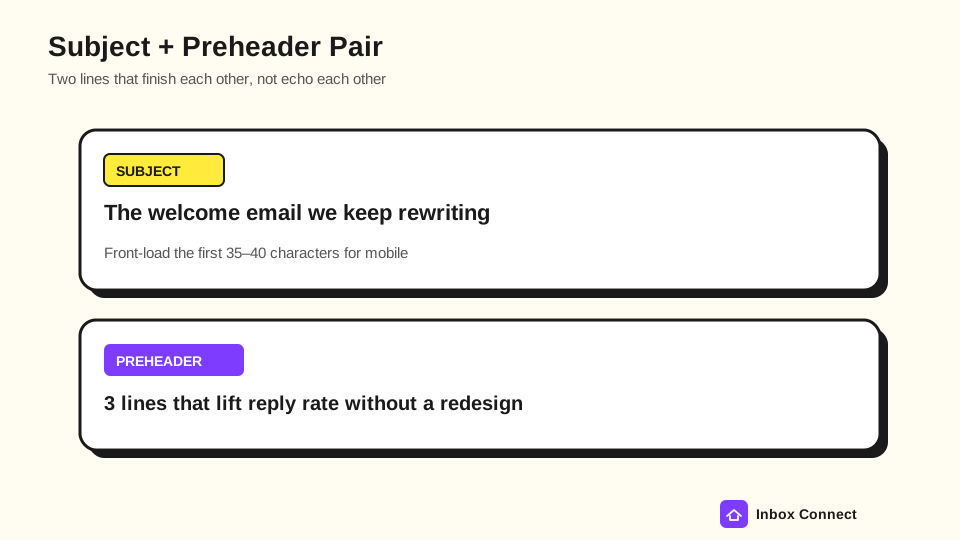
Litmus recommends keeping subject lines concise, roughly around nine words or about 60 characters, and front-loading the message because mobile inboxes cut earlier (Litmus). Aim to make the first 35 to 40 characters carry the meaning on their own.
The comparison below shows weak pairs versus pairs that work together:
| Weak Pair | Strong Pair | |
|---|---|---|
| Subject | Don't miss this week's update | The welcome email we keep rewriting |
| Preheader | Don't miss this week's update from our team | 3 lines that lift reply rate without a redesign |
| Problem | Echoes the subject and says nothing specific | Adds the missing detail and names the payoff |
| Reader Feeling | Vague, easy to skip | Clear trade for their attention |
Subject and preheader writing habits that hold up include the following:
- Be Specific: Name the topic, number, or outcome instead of teasing with empty curiosity.
- Skip Fake Urgency: Manufactured "urgent" language trains readers to distrust you.
- Match the Promise: If the subject sells a teardown, the email must deliver a teardown.
- Test Pairs, Not Just Subjects: Change both lines when you A/B test so the preview stays coherent.
Pro tip: Write five subject lines, then write a preheader that could only belong to the winner. If the preheader fits every draft, it is too generic.
Find a voice readers recognize
Voice is the consistent way your newsletter sounds: word choice, rhythm, humor, and how direct you are. Readers finish issues from people they feel they know, even when the writer is a brand.
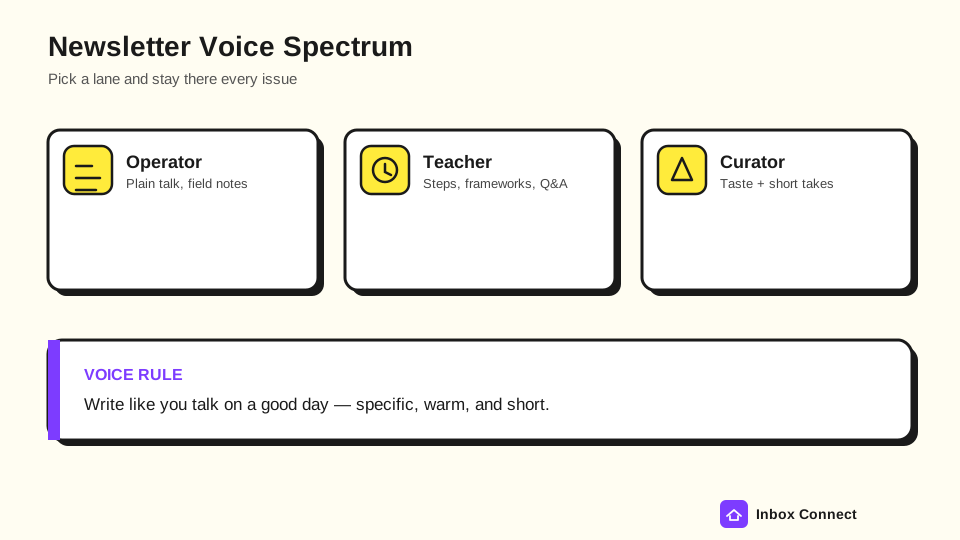
Most newsletters land in one of three lanes:
- Operator: Field notes, plain talk, and "here's what we tried" stories.
- Teacher: Frameworks, steps, and clear answers to repeated questions.
- Curator: Taste plus short commentary that saves the reader time.
Pick one primary lane and stay there for at least a quarter. Switching from punchy operator notes to formal corporate prose every other week breaks the reading habit.
A few voice rules we use with clients:
- Write like you talk on a good day, then trim the filler.
- Prefer concrete nouns and verbs over abstract marketing nouns.
- Use italic asides sparingly for a human beat (like this), not as decoration on every paragraph.
- Read the draft out loud once. Awkward lines almost always sound awkward in the inbox too.
Editing checklist before you hit send
Editing is where most "almost good" newsletters become finishable. Budget ten focused minutes after the draft, not just a quick spellcheck.
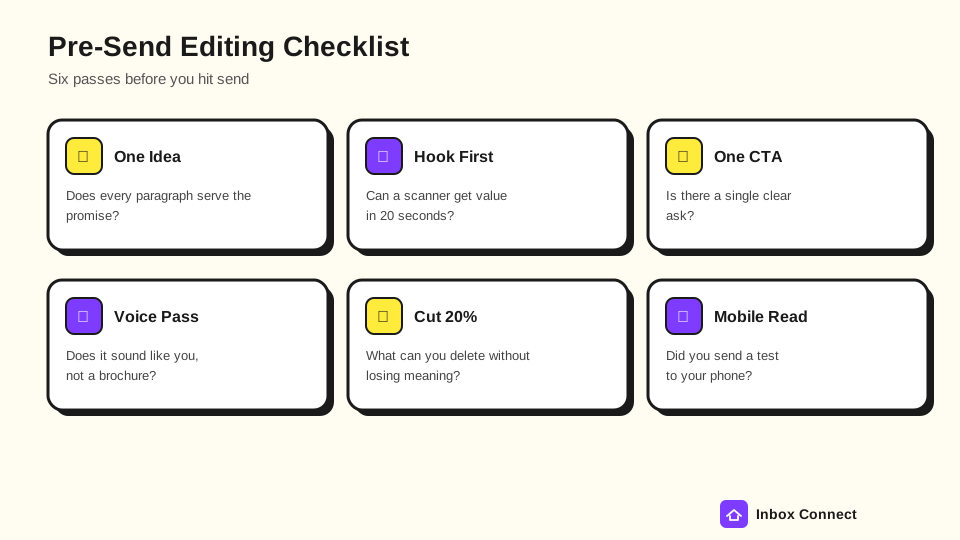
Run through this newsletter editing checklist before every send:
| Pass | Question to Ask | Fix If the Answer Is No |
|---|---|---|
| Promise | Does every section serve the one-sentence promise? | Cut or move off-promise sections |
| One Idea | Can you name the idea in a single line? | Split into two issues |
| Hook | Does the first screen deliver value without a warm-up? | Move the payoff to paragraph one |
| CTA | Is there one clear ask? | Delete competing buttons and links |
| Voice | Does it sound like you, not a brochure? | Rewrite stiff lines out loud |
| Cuts | Can you remove about 20% without losing meaning? | Kill throat-clearing and repeats |
| Mobile | Did you read a test send on your phone? | Fix truncation, spacing, and tap targets |
| Links | Do all links and personalization tags work? | Send yourself a fresh-address test |
For day-to-day sending habits beyond the draft, keep best practices for email newsletters nearby.
3 annotated examples (steal the pattern, not the niche)
Examples make the craft concrete. Below are three short annotated patterns you can adapt. These are writing patterns, not full layout templates.
Example 1: Operator lesson
Promise fit: One founder lesson for people shipping products.
Subject / preheader: "We killed our Friday send" / "What happened to replies when we went weekly"
Hook: Open with the decision and the result in two sentences.
Body: Tell the before/after, the one metric that moved, and the rule you'd keep.
CTA: "Reply with the cadence you're tempted to change."
Why it finishes: One decision, one result, one ask. No secondary sections compete for attention.
Example 2: Teacher how-to
Promise fit: A practical teardown for ecommerce operators.
Subject / preheader: "Fix the second welcome email" / "The line that turns browsers into repliers"
Hook: Name the exact problem the reader already feels.
Body: Show three short steps, each with a sample line they can paste.
CTA: "Forward this to the person who owns your flows."
Why it finishes: Steps are scannable, the sample lines create quick wins, and the CTA is easy.
Example 3: Curator brief
Promise fit: Five links for growth marketers who hate noisy feeds.
Subject / preheader: "5 links, one take each" / "No fluff, no 40-tab rabbit holes"
Hook: One sentence on the theme of the week.
Body: Five links, each with a single commentary line that says why it matters.
CTA: "Reply with a link I should include next week."
Why it finishes: Strict format trains the scan path. Commentary stays short so the issue never balloons.
Notice what these examples skip: long intros, multiple CTAs, and topic soup. That restraint is the craft.
FAQ
How long should a newsletter be?
A newsletter should be as long as the one idea needs and no longer. Many operator issues land between 400 and 900 words; a tight issue people finish beats a long issue they abandon halfway.
How do I start writing a newsletter if I'm stuck?
Start with the promise sentence, then pick one reader question from sales calls, support tickets, or replies. Write the hook that answers that question, then add only the proof the answer needs.
Should my newsletter sound formal or casual?
It should sound like a competent person in your space, not like a press release. Casual still needs clarity; formal still needs warmth. Consistency matters more than picking the "right" point on the spectrum once.
How many CTAs should a newsletter have?
One primary CTA. You can include a soft secondary path, such as a reply prompt plus one link, but competing buttons usually lower action rates because readers freeze.
Do I need to be a great writer to write a newsletter?
No. You need a clear promise, one idea, honest subject lines, and a ruthless edit. Great writers help, but finished thinking helps more.
How is writing a newsletter different from writing a blog post?
A newsletter is consumed in the inbox, often on a phone, with a shorter attention window and a standing relationship. Blog posts can afford more setup. Newsletters reward answer-first openings and a single throughline.
Ready to write issues people finish?
You came here to learn how to write a newsletter people actually finish, and the path is clear: lock the promise, protect one idea per issue, structure hook-body-CTA, pair subject and preheader, then edit like the send depends on it (because it does).
Our recommendation is simple. Draft your promise sentence today, bank two issues with one idea each, and run the editing checklist before the first send. If you want help turning that craft into a system on beehiiv, Inbox Connect can set up the platform, welcome flow, and issue plan so writing time goes into the words that matter.
Write newsletters that get finished Get beehiiv setup, a welcome sequence, and a writing system built around issues people actually complete. Book a newsletter strategy call →