Are you looking for lead magnet ideas that bring in people who will actually buy from you? The ones that convert solve one small problem your buyer already has, like a fit quiz, a sizing guide, or a ten-minute checklist, and they point straight at the thing you sell.
Pick the wrong one and your list grows while sales stay flat. Worse, freebie hunters start ignoring or reporting your emails, and Gmail's Email sender guidelines tell senders to keep spam rates in Postmaster Tools below 0.3%.
Klaviyo's own sign-up form analytics guide says to aim for a popup submit rate of about 3% or higher, then judge new subscribers by how they engage with your welcome series. I build and run Klaviyo accounts for ecommerce brands at Inbox Connect, and those two numbers are how I judge any lead magnet (a big submit rate on its own tells me very little).
Below, I'll walk you through 12 lead magnet ideas by business type, the ones that fill your list with junk, the mix I'd run, and the delivery email that turns a download into a first order. By the end, you'll know which one to build this week, so your list grows with people who can become customers.
Let's start with what a lead magnet has to do.
In this article
- What is a lead magnet and what should it do?
- 12 lead magnet ideas by business type
- A live lead magnet example: the Inbox Connect Leak Finder
- Conversion vs list quality: the magnets that inflate junk lists
- The lead magnet mix I'd run
- The delivery email that makes it work
- FAQ
- Final Thoughts
What Is a Lead Magnet and What Should It Do?
A lead magnet is a free, useful thing you trade for an email address, and its real job is to start a buying conversation. A coupon, a quiz, a checklist, and a template can all be lead magnets, as long as the person who wants it is likely to want your product too.
That last part is where weak lead magnets fail. If your freebie appeals just as much to someone who will never buy, your sign-up form becomes a traffic counter.
A lead magnet that converts does these three jobs:
- It Solves One Specific Problem: The reader can say what they got in one sentence. "A sizing chart for wide feet" beats "Our Ultimate Footwear Guide" because the first one names a problem a buyer has right now.
- It Pays Off in Minutes: A checklist they can finish over coffee gets used. A 60-page ebook gets forgotten, along with the brand that sent it.
- It Points at the Paid Thing: The natural next step after using the magnet should be your product or service. A fit quiz ends on a product match, and an audit checklist ends on the fix.
Weak vs strong lead magnet offers
Weak: "Join our newsletter for updates and exclusive content." Nobody knows what they're getting, so only your most loyal visitors bother, and they were already going to buy.
Strong: "Take the 60-second skin quiz and get a three-step routine for your skin type, plus 10% off the first product in it." The visitor gets a personal answer, and the answer is a shopping list.
Pro tip: Write the one-sentence promise before you design anything. If you can't finish "After this, you'll know..." with something your buyer cares about, the magnet isn't ready.
12 Lead Magnet Ideas by Business Type
The lead magnet ideas below are grouped by the kind of business they suit best, because a format that converts for a skincare store can flop for a SaaS tool. I've rated each one on buyer intent (how closely it tracks a purchase) and junk risk (how likely it is to attract freebie hunters).
| # | Lead magnet idea | Best for | Buyer intent | Junk risk |
|---|---|---|---|---|
| 1 | Product finder or fit quiz | Ecommerce with many SKUs or a "which one is for me?" question | High | Low |
| 2 | Sizing, shade, or fit guide | Apparel, footwear, beauty | High | Low |
| 3 | First-order offer tied to a product | Most ecommerce stores | High | Medium |
| 4 | Restock alert or early-access list | Drops, limited runs, seasonal products | High | Low |
| 5 | Free tool, calculator, or checker | SaaS and B2B services | High | Low |
| 6 | Template or swipe file | SaaS, agencies, creators | Medium | Medium |
| 7 | Five-day email course | SaaS, coaching, info products | Medium | Medium |
| 8 | Original benchmark report | SaaS and B2B with real data | Medium | Low |
| 9 | Diagnostic checklist or scorecard | Agencies, consultants, services | High | Low |
| 10 | Teardown or breakdown of real work | Agencies and freelancers | Medium | Low |
| 11 | Workshop or webinar replay | Coaching, B2B, high-ticket offers | Medium | Medium |
| 12 | Giveaway or sweepstakes | Launches and list resets, used sparingly | Low | High |
Ecommerce and DTC stores
For stores, the best lead magnet examples answer the question a shopper asks right before they buy. A product finder quiz does that directly, because the result is a product recommendation and the email you send next can open with it.
Sizing and shade guides work the same way for apparel and beauty. Someone downloading "How to measure your foot for our wide-fit range" has already decided they might buy (they're just scared of a return).
The first-order discount is the default, but a generic one attracts deal hunters. Tie it to a product or routine and it filters for intent.
Restock alerts and early-access lists go further, because the subscriber has already picked the product.
Pro tip: If you run a discount offer, show it after one qualifying question like "What are you shopping for today?" You still get the sign-up, and you get a segment you can use in the very first email.
SaaS and software
For software, the strongest lead magnet is a free slice of the product's outcome. A calculator, a checker, or a generator lets someone feel the result before they pay, and anyone who uses a tool to price their own problem is a warm lead.
Templates and email courses sit in the middle, because they also attract students and competitors. Gate one only when your product makes the job easier (a "churn email template" from a retention tool fits).
Benchmark reports only work when the data is yours and the numbers are real. A "report" built from recycled stats gets spotted fast.
Agencies, consultants, and service businesses
Services sell trust, so the best lead magnet is a small piece of the diagnosis you'd run for a paying client. A checklist or scorecard lets the prospect find their own problem, and the person who finds three problems is the one who books a call.
Teardowns and workshop replays show how you think, but they take longer to consume. Put a two-minute summary at the top.
Giveaways sit at the bottom of the table deliberately. A sweepstakes for a general prize brings in a burst of sign-ups, and most of them wanted the prize, not you.
A Live Lead Magnet Example: The Inbox Connect Leak Finder
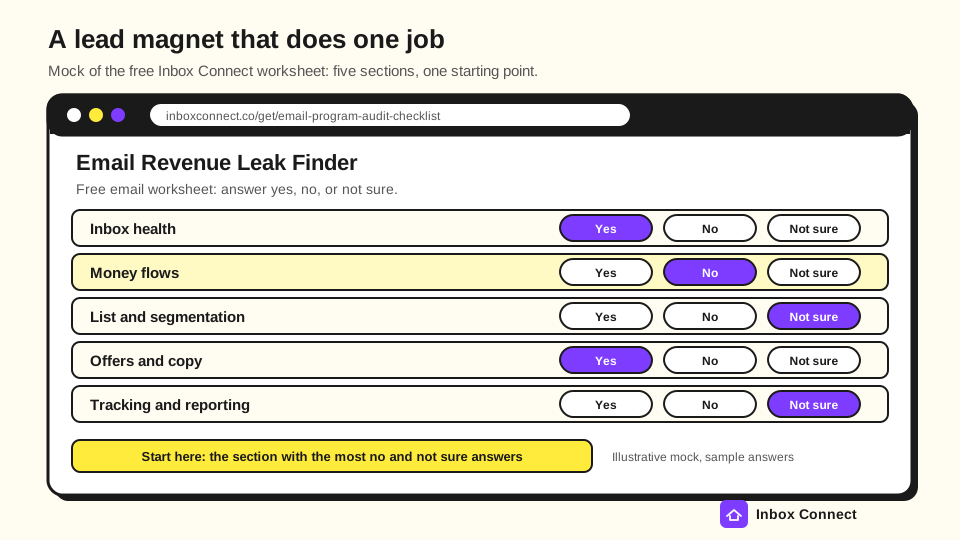
I don't want to hand you advice I haven't used myself, so here's the lead magnet on the Inbox Connect site. The Email Revenue Leak Finder is a free worksheet for store owners who suspect email is underperforming but don't know where.
It asks simple yes, no, or not sure questions across five sections: inbox health, money flows, list and segmentation, offers and copy, and tracking and reporting. The section with the most "no" and "not sure" answers tells the reader where to start.
Here's why it's built that way, using the three jobs from earlier:
- One problem: It answers "Where is my email losing money?" and nothing else. There's no chapter on the history of email marketing.
- Fast payoff: Yes, no, or not sure answers take minutes, and the reader finishes with a starting point instead of homework.
- Points at the paid thing: The next step asks the reader to send their site, email platform, and the section with the highest "no" count. That's exactly what I'd need to start a Klaviyo account review, so the magnet and the service are one path.
Pro tip: Make the last screen of your lead magnet ask for the one piece of information you'd need to help the reader next. It turns a download into a reply, and replies are the best list-quality signal you can get.
Conversion vs List Quality: The Magnets That Inflate Junk Lists
A junk list is full of real email addresses that belong to people who will never buy. They grab the freebie, go quiet, and drag down engagement for the whole list.
The lead magnets that cause this share one trait: the reward has nothing to do with your product. Here are the usual suspects:
- Unrelated Giveaways: "Win a $500 gift card" attracts everyone who likes gift cards. A cash-style prize can swell a list in a weekend without adding a single buyer.
- Generic Ebooks: "The Ultimate Guide to Healthy Living" competes with every free article on the internet. People take it because it's free, not because they have a problem you solve.
- Steep Sitewide Discounts: A large discount shown to every visitor trains your list to wait for codes. You also pay that discount to people who were going to buy at full price anyway.
Weak vs strong giveaway
Weak: "Enter to win a $500 Amazon gift card!" Your entries come from sweepstakes fans, and your next campaign goes out to a crowd of people who never heard of your brand.
Strong: "Win our full winter skincare set (worth $180), and everyone who enters gets the routine guide for dry skin." The prize only appeals to people who want your products, and the runner-up gift is a useful lead magnet in its own right.
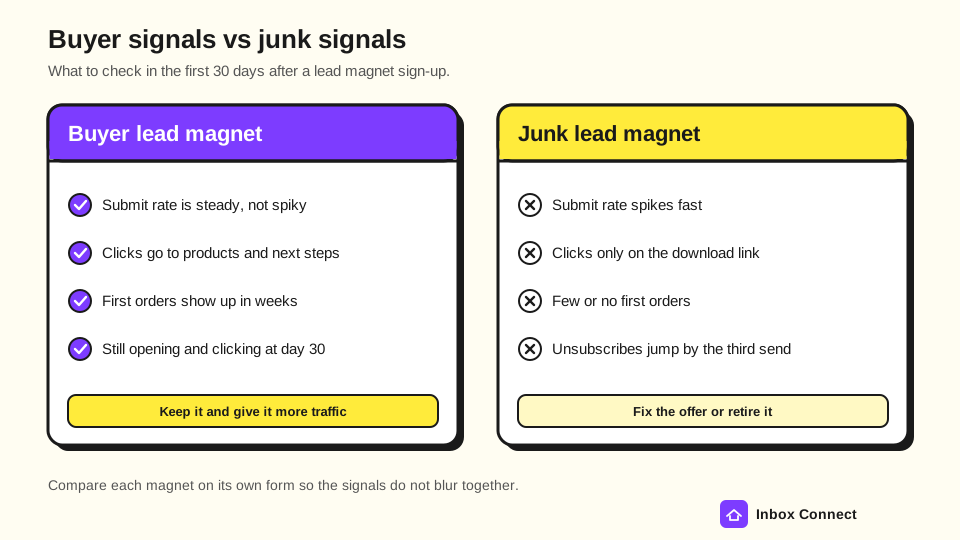
The fix is to measure lead magnets on more than the sign-up. Here are the signals I compare when two lead magnets run side by side:
| Signal | Buyer lead magnet | Junk lead magnet | Where to check in Klaviyo |
|---|---|---|---|
| Form submit rate | Steady, often lower than a giveaway | Spikes fast | Sign-up form analytics, Overview tab |
| Clicks in the welcome email | Clicks go to products or the next step | Clicks only on the download link | Flow analytics for your welcome series |
| First orders from the form | Orders show up within the first weeks | Few or none | Form analytics with Placed Order selected |
| Unsubscribes and spam complaints | Low after the first send | Jump after the second or third send | Campaign and flow reports |
| Engagement after 30 days | Still opening and clicking | Gone quiet | Engaged vs unengaged segments |
Klaviyo lets you switch a form's conversion metric to Placed Order, and by default it credits purchases made within two hours of a submission. That's a tight window, so also watch your welcome series, which is exactly where Klaviyo's guide tells you to look for list quality.
Pro tip: Give every lead magnet its own form and its own source property, even if they feed the same list. Without that, you can't tell which magnet brought in the buyers and which one brought in the tourists.
If a giveaway already left you with a pile of quiet subscribers, run a sunset flow and follow my email list cleaning process before your next big send.
The Lead Magnet Mix I'd Run
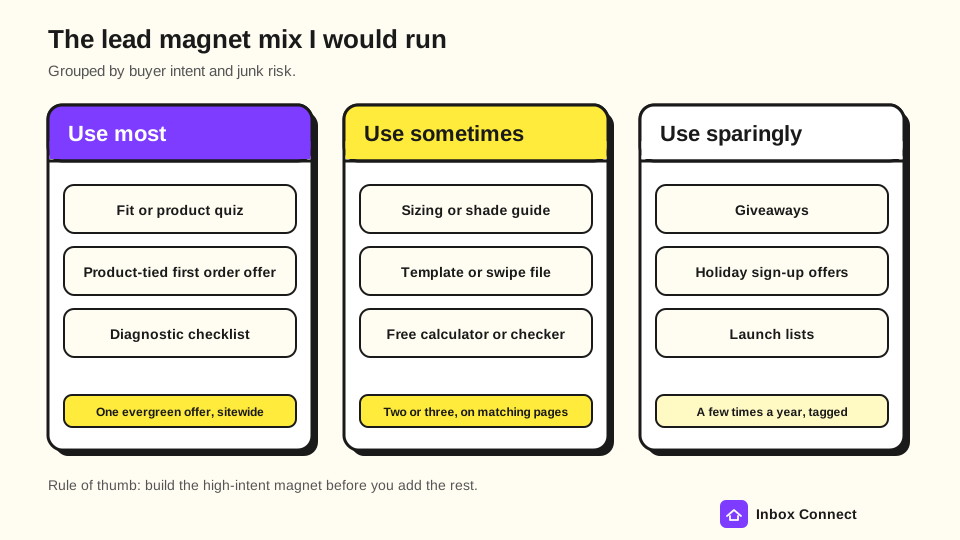
You don't need twelve lead magnets. One main offer, a couple of content magnets, and a rare promotional push is enough to start.
Here's the mix I'd start with:
- Use Most, Your One Evergreen Magnet: This is the highest-intent offer from the table, shown in your main popup and on your homepage. For a store it's usually a fit quiz or a product-tied first-order offer, and for a service it's a diagnostic checklist.
- Use Sometimes, Two or Three Content Magnets: These are templates, guides, or tools placed inside the blog posts and pages where they match the reader's problem. A sizing guide belongs on a sizing article, not in a sitewide popup.
- Use Sparingly, Promotional Spikes: Giveaways, holiday sign-up offers, and launch lists go here. Run them a few times a year, tag the sign-ups, and clean out the ones who never engage.
For form placement and copy, my newsletter sign-up examples break down ten real forms. For the full list-building process, see how to build an email list.
The Delivery Email That Makes It Work
The delivery email is the one message a new subscriber is actively waiting for, so it should do more than hand over a link. It confirms the person made a good choice, delivers the thing, and gives them one next step.
Weak vs strong delivery email
Weak: Subject "Your download is here." The body says "Thanks for signing up! Click here to get your guide," and that's the whole email.
Strong: Subject "Your wide-fit sizing guide (plus the 2 styles that fit best)." The body delivers the guide at the top, then shows the two styles wide-footed customers buy most, with one button to see them.
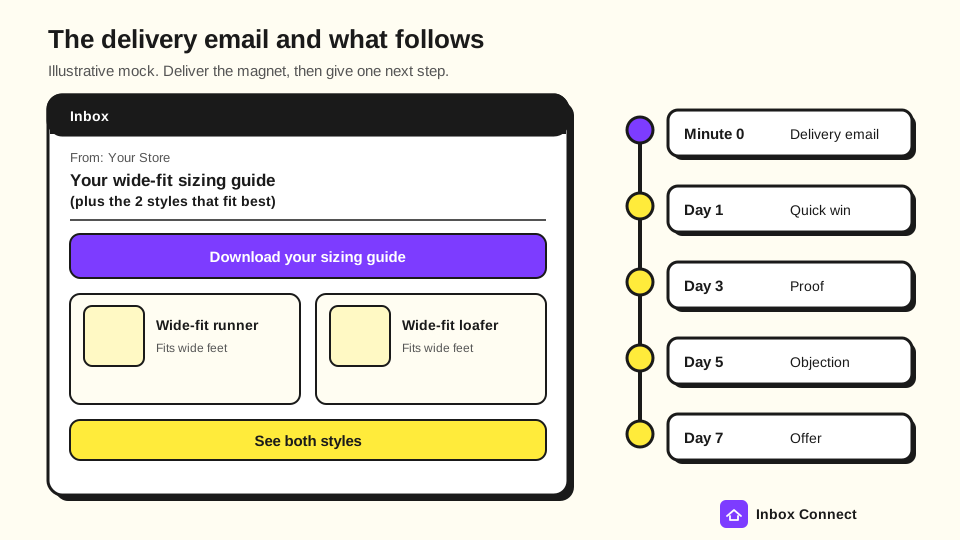
A short follow-up sequence then carries the conversation toward a sale. Here's the day-timed cadence I'd use:
| When | Its one job | |
|---|---|---|
| Minute 0 | Delivery email | Hand over the magnet and suggest one product or step |
| Day 1 | Quick win | Show how to use the magnet in under five minutes |
| Day 3 | Proof | Show the product solving the same problem, using real reviews you have permission to quote |
| Day 5 | Objection | Answer the one question that stops people buying (fit, price, returns, setup time) |
| Day 7 | Offer | Make a clear, time-bound offer or invite a reply |
If you use double opt-in, the delivery email should arrive the moment they confirm. My guide to double opt-in email covers when that extra step is worth it.
For the rest of the sequence, my welcome email sequence guide has the full structure. To draft it faster, try the free welcome sequence generator.
Pro tip: Put the download link in the first screen of the delivery email and again at the bottom. People who can't find the thing they signed up for are the ones who mark you as spam.
FAQ
What are some good lead magnet examples?
Good lead magnet examples include a product finder quiz, a sizing or shade guide, a restock alert list, a free calculator, and a diagnostic checklist. Each one solves a problem a buyer has right before purchasing, which is why they convert better than generic ebooks.
Do discount codes count as lead magnets?
Yes, a discount code is a lead magnet, and it's the most common one in ecommerce. It works best tied to a product, because a steep sitewide code attracts shoppers who only buy on sale.
How long should a lead magnet be?
A lead magnet should be as short as it can be while still solving the problem, ideally usable in under ten minutes. A one-page checklist gets used, while a long ebook gets saved and forgotten.
Should I use double opt-in for a lead magnet?
Double opt-in is worth it if you get a lot of fake or mistyped addresses, because it keeps those off your list. The trade-off is that some real people never confirm, so send the delivery email the moment they click the confirmation link.
How do I know if a lead magnet is bringing in junk subscribers?
Compare welcome email clicks, first orders, and unsubscribes for each lead magnet over the first 30 days. A high submit rate with few clicks and orders means freebie hunters.
Final Thoughts
You came here for lead magnet ideas that bring in buyers, and you now have 12 of them sorted by business type, the warning signs of a junk magnet, a simple mix, and a delivery sequence that carries a sign-up toward a sale. The short version: build one high-intent magnet that answers the question buyers ask right before they buy, and judge it on welcome clicks and first orders, not sign-ups alone.
My recommendation for this week is specific. Pick the single question your customers ask most before purchasing, turn the answer into a checklist, quiz, or guide, and write the delivery email before you design the form.
If you want to see how I'd structure one, download the Email Revenue Leak Finder and use it as your template. Then fill it in for your own store, because the section with the most "no" answers might be where your list growth is leaking too.
If you'd rather have someone else take the first look, request a free email audit and you'll get a ranked list of fixes for your Klaviyo account in about 48 hours.
Russ